
Author
Kirsty Maclean
Global Head of R&D
Author
Kirsty Maclean
Global Head of R&D
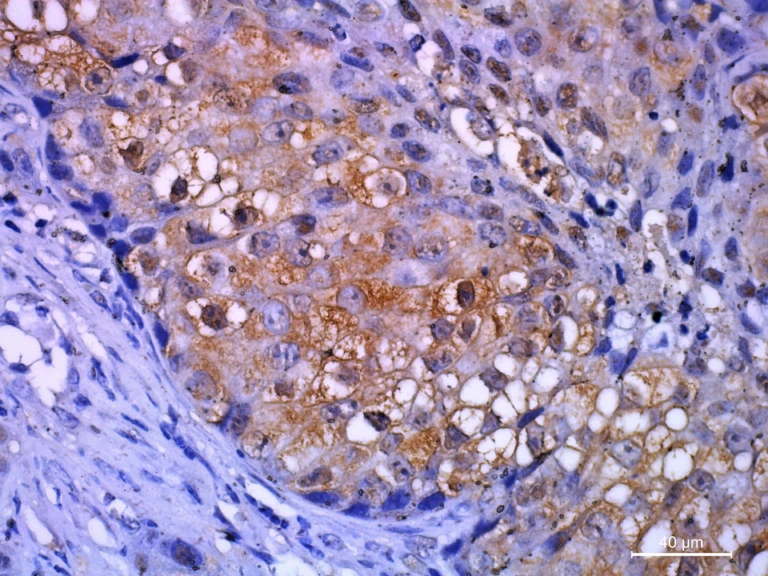
Immunohistochemistry (IHC), using highly specific monoclonal antibodies (mAbs), shows whether a tumor antigen is present, at what level, and whether the signal comes from malignant cells rather than surrounding stromal or inflammatory components.1,2 It’s why IHC remains a cornerstone of target validation in both diagnostic and therapeutic development.2
But the value of IHC depends on the assay. Variability in assay design, pre-analytical conditions, and interpretation can change which patients are selected for a trial and how clearly a therapy’s effect shows, particularly where tumors are heterogeneous within and between lesions.3
Scoring systems and cutoffs also need to align with clinical endpoints and regulatory expectations, and in global trials, tissue handling, staining and interpretation must stay consistent from site to site. When they don’t, the impact reaches beyond assay variability to patient classification and the reading of therapeutic response, as HER2-low breast cancer and PD-L1 testing both show.5,6
In the past, IHC assays for HER2 grouped tumors into two categories: HER2-positive (IHC 3+ or amplified) and HER2-negative (IHC 0 or 1+). These assays were not designed to reliably distinguish between IHC 0 and 1+. Factors such as tissue fixation, antibody clone selection, and interpretation inconsistencies could lead to false negatives. 3 Some patients with true HER2 expression were mistakenly excluded from clinical trials. Furthermore, suboptimal IHC strategies diluted efficacy signals and underestimated treatment effects. Only after refining IHC strategies did HER2-low and indeed HER2-ultra low emerge as clinically actionable, for example with trastuzumab deruxtecan.4,5
PD-L1 IHC, used as a companion diagnostic for immune checkpoint inhibitors, faces several challenges. Assays are not always analytically equivalent, and the same tumor sample can be defined as PD-L1 positive by one assay and negative by another.6 Heterogeneous and inducible PD-L1 expression further complicates interpretation. These issues can result in inappropriate exclusion of patients from therapy, weaker or inconsistent efficacy signals in trials, and unreliable cross-trial comparisons. Such challenges have been observed in non-small cell lung cancer (NSCLC) and triple-negative breast cancer (TNBC) trials. 6
In real-world scenarios, suboptimal IHC strategies can create erroneous biomarker profiles, ultimately obscuring true trial endpoints and weakening efficacy signals. This highlights the need for highly specific mAbs, rigorous assay validation, and standardized scoring systems.
To address these challenges, we promote best IHC practices to capture results that reflect true antigen expression, including intra-tumoral and inter-lesion heterogeneity. Key best practices include:
Good IHC practice supports:
When executed correctly, IHC confirms that a proposed antibody target is present in the right cells, at the right levels, and in the right spatial context before and during clinical development.1
If you’re developing targeted or immunotherapies, our integrated biomarker and assay development capabilities can help you generate reliable, clinically meaningful insights from every sample.
We combine expertise in IHC, biomarker testing, NGS, flow cytometry, and bioanalysis to help sponsors generate reliable data for target validation, patient selection, and treatment evaluation. Supporting modalities ranging from monoclonal antibodies and ADCs to bispecifics and cell therapies, our global laboratory network delivers the standardized workflows and scientific insight needed to take your program to the next phase.
Explore our oncology solutions or connect with our experts to see how we can support your next study.
Explore immuno-oncology biomarker strategies using flow cytometry, IHC, and NGS to improve tumor profiling, immune insights, and clinical trial outcomes.
Oncology trials are undergoing a transformative shift, developing therapies that directly target cancer cells and aim for more efficient treatments with a better safety profile. This approach aims to improve quality of life, extend progression-free survival rates for cancer patients, and increase overall survival.
One of the most significant challenges facing biopharmaceutical and biotechnology companies is translating complex science into meaningful clinical outcomes. Kirsty Maclean, Global Head of R&D, talks about how our integrated framework helps accelerate decision-making.

