

Author
Kim Whitley
Scientific Content Manager
Author
Kim Whitley
Scientific Content Manager
This was reflected in several key themes at Options for the Control of Influenza XIII Conference, held August 30–September 2 in Washington, DC. Across scientific sessions, posters, and conversations with colleagues, several themes stood out: the continued development of cell-based approaches, growing interest in scalable and automated immune response assessment, and an expanding role for sequencing in global influenza surveillance.
Underlying all three themes was a broader shift. Influenza research is moving beyond reliance on established methods and toward pairing new technologies with scalable lab strategies that support faster decisions.
Read more about what these developments mean for the labs supporting this work.
Vaccine development and manufacturing were prominent themes at Options XIII, with discussions exploring how established approaches can evolve to meet the demands of a rapidly changing virus.
Sessions and posters considered ways to improve scalability and turnaround times, alongside continued discussion of different approaches to vaccine production. Cell-based vaccine development featured prominently, particularly in the context of developing approaches that can respond to the pace of influenza evolution.
For laboratories supporting vaccine development, this places greater emphasis on testing approaches that can generate robust data while also meeting the timelines and scale of modern development programs.
Today, cell-based influenza assays and vaccine manufacturing offer significant biological, clinical, and operational advantages over traditional egg-based approaches. Unlike egg-based systems, cell-based platforms eliminate the risk of egg adaptation, a process in which influenza viruses acquire mutations during propagation in eggs that can alter their antigenic characteristics.
By utilizing mammalian cell lines, such as MDCK cells, these systems more faithfully preserve the genetic and antigenic properties of circulating human influenza strains. As a result, they can support improved assay accuracy and enhance the relevance of generated laboratory data.
In addition, cell-based manufacturing offers important operational benefits, including scalable production through controlled bioreactor systems, reduced production timelines, and independence from egg supply chains. This reduces vulnerability to agricultural disruptions, including avian influenza outbreaks that can affect poultry populations and impair egg availability.
A central scientific theme at the meeting was the modernization of immune response measurement to support the evaluation of next-generation vaccine platforms.
Together, these advances signal a move away from single-marker assessments of immunity and toward multidimensional, high-throughput immune profiling. This shift should sharpen predictions of vaccine effectiveness, accelerate the development of universal and next-generation influenza vaccines, and give regulators and clinicians stronger frameworks for evaluating respiratory virus vaccines.
Among the research presented was new data from Shionogi’s phase III SCORPIO-PEP clinical trial evaluating ensitrelvir for post-exposure prophylaxis of COVID-19. Working closely with the study team, Cerba Research conducted viral genotyping and phenotyping assays and supported the verification of SARS-CoV-2 whole-genome sequencing data needed to support the trial.
Further research presented at Options XIII explored antiviral efficacy and the emergence of potential resistance-associated viral variants among participants treated with ensitrelvir. The findings demonstrate the value of robust viral characterization in understanding treatment response and generating the evidence needed to advance antiviral development.
Sequencing was another strong theme across the conference, with conversations highlighting its role in monitoring influenza viruses and understanding how they evolve.
Molecular surveillance programs featured in discussions across multiple countries, including Argentina, Chile, and Japan. This breadth reflects the need for surveillance approaches that can generate useful data across different populations, geographies, and program settings.
There was also discussion around the different sequencing technologies being used to support this work. Established short-read approaches such as Illumina were discussed alongside growing interest in long-read technologies such as Oxford Nanopore Technology (ONT).
As the long-standing market leader in NGS, Illumina delivers exceptional accuracy and cost-effective high-throughput sequencing depth, making it highly effective for detecting low-frequency mutations and minor variants within influenza populations. In contrast, ONT excels at sequencing entire influenza genomic segments in single, uninterrupted long reads. This capability reduces the assembly challenges commonly encountered with segmented viral genomes, enabling direct characterization of complex co-infections, reassortment events, and segment linkage in near real time.
While Illumina remains the benchmark for sequencing throughput and single-base accuracy, ONT offers distinct advantages through its rapid turnaround time, portability, and real-time data generation, making it a compelling platform for responsive surveillance and outbreak monitoring.
The choice between these approaches, however, depends on the scientific question, the type of information required, and the wider objectives of the surveillance program.
The development of new technologies also brings a need for greater consistency in how testing is performed and data are generated and interpreted.
As influenza testing technologies advance, maintaining standardized, reproducible methods remains essential to ensure consistent, comparable data across studies and regions. At the same time, evolving regulatory requirements, including FDA controls in the United States and the European IVDR framework, are raising expectations for assay performance, validation, surveillance, and strain relevance.
Influenza took center stage at Options XIII, but the conversation didn’t stop there. RSV featured in discussions of surveillance and immune monitoring, reflecting a growing need to understand multiple respiratory pathogens within a single development program.
As vaccine and antiviral pipelines expand across respiratory diseases, the questions raised at Options XIII apply well beyond influenza. Researchers need laboratory strategies that deliver consistent, high-quality data across pathogens and keep pace with evolving regulatory and development requirements.
Whether the goal is to evaluate vaccine responses, track viral evolution, or measure antiviral activity, meaningful data depends on three things working together: specialized virology expertise, robust assay platforms, and scalable laboratory operations. As respiratory programs grow more sophisticated, applying that combination across pathogens becomes a real advantage.
At Cerba Research, we bring this approach to programs spanning influenza, RSV, and other emerging respiratory viruses, helping sponsors generate the data they need to move candidates from early development through clinical evaluation.
Are you working on an influenza or vaccine program? Connect with our team to explore the laboratory approaches that can help support your development goals.
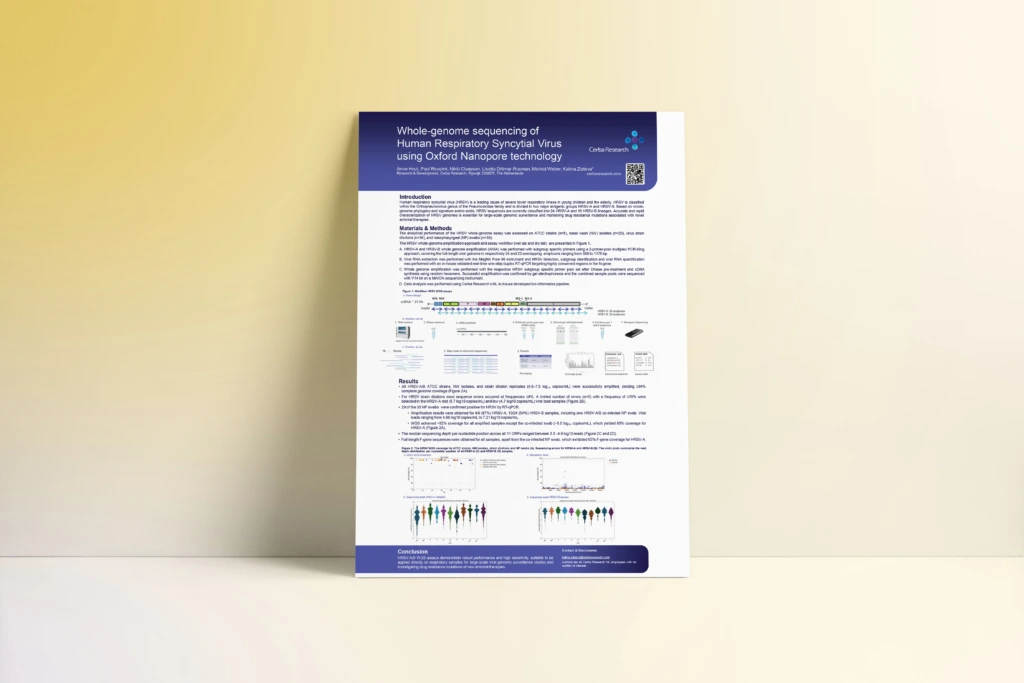
Clinical studies demand highly reliable, well‑characterized assays. At the event, we presented a poster highlighting the analytical performance of our whole genome sequencing (WGS) assays for RSV in clinical research settings, showing how this can contribute to surveillance studies.
Explore RSVW 2026 insights on RSV research, covering antivirals, vaccines, maternal immunization, monoclonal antibodies, and whole genome sequencing advances.
Learn more about our specialized support for infectious disease programs and vaccine and antiviral development, from discovery through clinical development.

Explore preclinical services combining model development, efficacy testing, and translational insight to support clinical success.